
If you sit at a desk for 6 to 8 hours a day, you are likely familiar with that dull, aching throb in your lower back. You might try standing up, stretching your hamstrings, or buying a fancy ergonomic chair, but the pain often returns by 3 PM.
The issue is rarely just "a sore back." It is a mechanical problem caused by the position of your hips. When you sit, your hip flexors are in a shortened position for hours. Over time, they adapt and become chronically tight.
When you finally stand up, those tight hip flexors pull your pelvis forward (Anterior Pelvic Tilt), which jams your lumbar spine together. Here are 3 ways we address this at The Cove.
The Psoas is a deep hip flexor that attaches directly to your lumbar spine. When it is tight, it acts like a rope constantly pulling your lower back into compression.
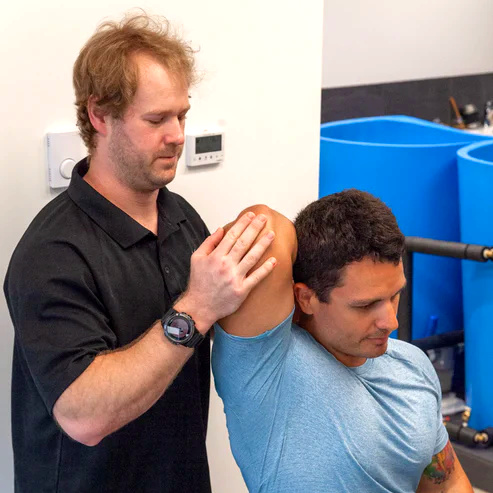
Because it is buried deep under your abs, you cannot foam roll it effectively. In an MST session, I use manual release techniques to safely access the psoas and get it to let go. For many clients, this provides instant relief that back massage alone never achieves.
When your hip flexors are tight, they chemically inhibit your glutes (your butt muscles). Essentially, your brain turns your glutes off.
Your glutes are supposed to support your back. When they are offline, your lower back muscles (Erector Spinae) have to do double the work to keep you upright. We use activation drills to "turn the power back on" to your glutes so your back can finally take a break.
Your lower back is meant to be stable. Your upper back (Thoracic spine) is meant to be mobile. But when you hunch over a keyboard, your upper back gets stiff.
If your upper back won't move, your lower back has to move too much to compensate. By restoring rotation and extension to your upper back, we stop the lower back from being overworked.
You don't need a new chair; you need to unlock your hips. Come and see me for an MST session and let's get you pain-free. Now located inside Train West Van.